
From Jira Chaos to an Operating Model: A Jira Governance Case Study
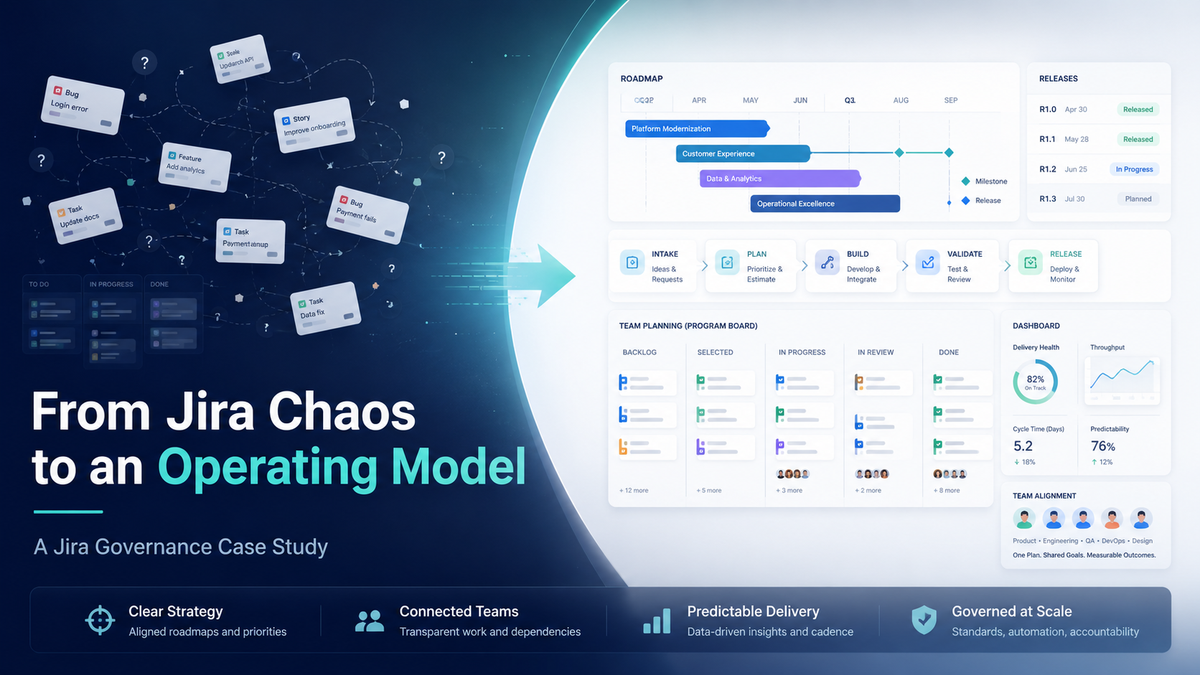
Hot Take: Jira is rarely the real problem.
Most engineering organizations that tell us, “Our Jira is a mess,” do not actually have a tooling problem. They have a consistency problem.
Different teams use different workflows. Epics mean different things depending on who created them. Release information lives in someone’s head. Customer requests arrive through one process, product requests through another, and engineering work is tracked differently again. Leadership wants a roadmap, but the underlying Jira data is not structured well enough to build one they can trust.
That was the situation we walked into with a recent client.
The organization had four engineering teams, multiple product stakeholders, customer-driven work competing with planned development, and an interest in getting more value out of Jira Product Discovery and Advanced Roadmaps.
The temptation would have been to configure the new tools immediately.
We did the opposite.
We started with governance.
The Problem Wasn't Jira. It Was the Lack of a Common Language.
Each engineering team was already using Jira. They had Epics, Stories, Tasks, Bugs, boards, and sprints. Nothing was catastrophically broken.
The challenge was that the teams weren't operating from the same set of rules.
Some work had no meaningful parent. Release tracking was inconsistent. Components weren't being used. Estimation approaches differed. Documentation lived outside the Atlassian ecosystem. Customer Service requests routinely affected sprint capacity, but that impact was difficult to see at a portfolio level.
There was also a larger strategic goal: leadership wanted cross-team planning.
They wanted to answer questions like:
- What are all four engineering teams working on?
- Which initiatives span more than one team?
- Which product areas are absorbing the most work?
- What is expected to ship in an upcoming release?
- How much work is coming from Customer Service versus planned product development?
- Where are dependencies going to create delivery risk?
Advanced Roadmaps can help answer those questions.
But only if Jira contains reliable data in the first place.
Governance Came Before Roadmaps
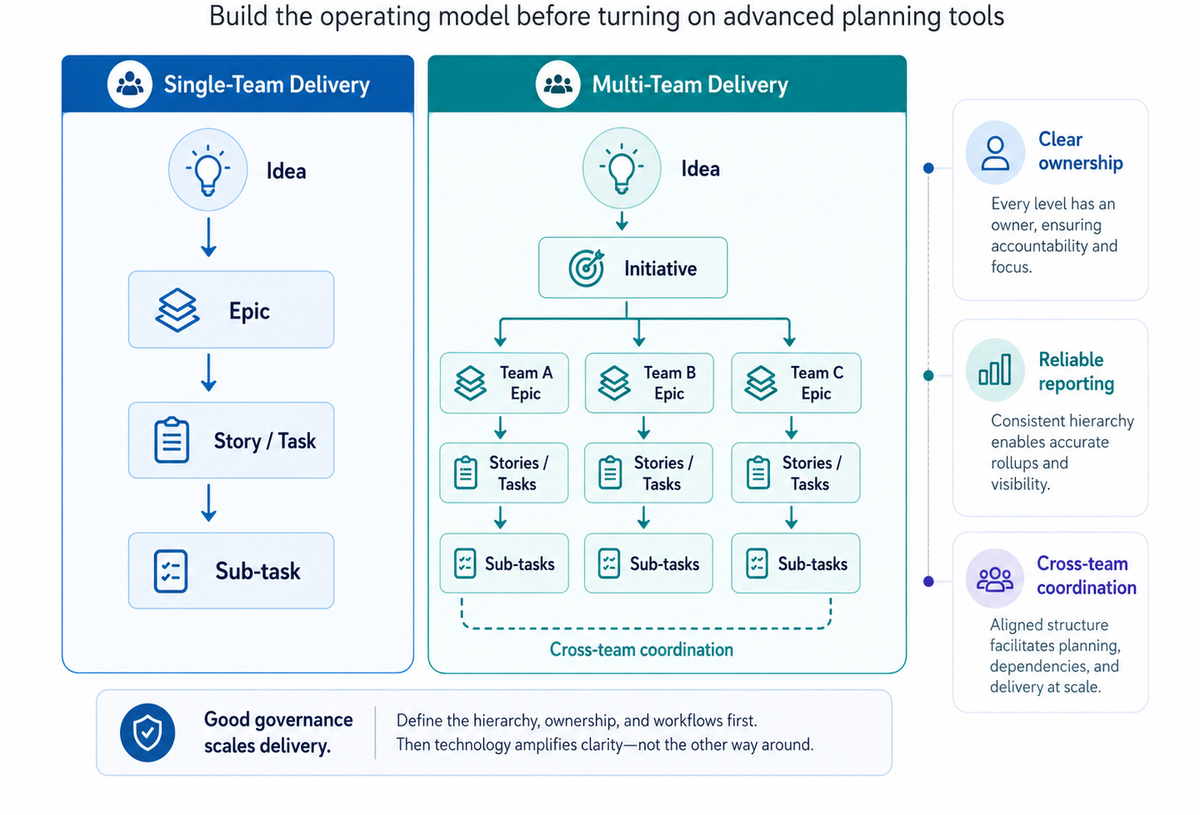
We began by defining what the Jira hierarchy actually meant.
For this organization, the model became:
Idea → Initiative → Epic → Story / Task → Sub-task
Not every Idea requires every level.
A product Idea owned by a single engineering team can move directly from Jira Product Discovery into an Epic in that team's Jira project.
When an Idea requires multiple engineering teams, an Initiative becomes the coordination layer. Each participating team owns its own Epic beneath that Initiative.
That distinction turned out to be important.
The Initiative represents the shared outcome.
The Epics represent what each engineering team is actually responsible for delivering.
That gave leadership a cross-team view without taking delivery ownership away from the teams.
We Standardized the Basics First
A roadmap is only as useful as the tickets underneath it.
So a significant part of the engagement focused on what might sound like basic Jira administration, but these were exactly the things preventing reliable planning and reporting.
We introduced common expectations around:
- Epic, Story, Task, Bug, and Sub-task usage
- Parent-child relationships
- Components
- Labels
- Priority
- Estimation
- Sprint hygiene
- FixVersions
- Release tracking
- PRD and TDD documentation
- Team and Tribe classification
- Required ticket fields
The objective wasn't to create bureaucracy.
It was to make Jira predictable.
An engineer moving between teams should not need to relearn what an Epic means. A product leader should not need four different reports to understand four teams. A dashboard should not require someone to manually reconcile missing metadata every Friday afternoon.
Governance is what makes that possible.
Product Discovery and Delivery Needed Different Jobs
One of the most important decisions was keeping discovery and delivery conceptually separate.
Jira Product Discovery became the place to answer:
Should we do this, and why?
Jira Software became the place to answer:
How are we going to deliver it?
Advanced Roadmaps became the place to answer:
How does all of this work fit together?
That sounds simple, but getting there required clear rules.
Ideas could originate from Product, stakeholders, or Customer Service. Once prioritized and ready for execution, delivery tickets were created in the appropriate Jira projects.
For multi-team work, an Initiative connected those delivery Epics together.
For single-team work, the Idea linked directly to the team's Epic.
That kept the hierarchy useful instead of adding layers simply because Jira allowed us to.
Documentation Became Part of the Workflow
The teams already valued Product Requirements Documents and Technical Design Documents, but those documents were being created outside Jira and Confluence.
We standardized that as well.
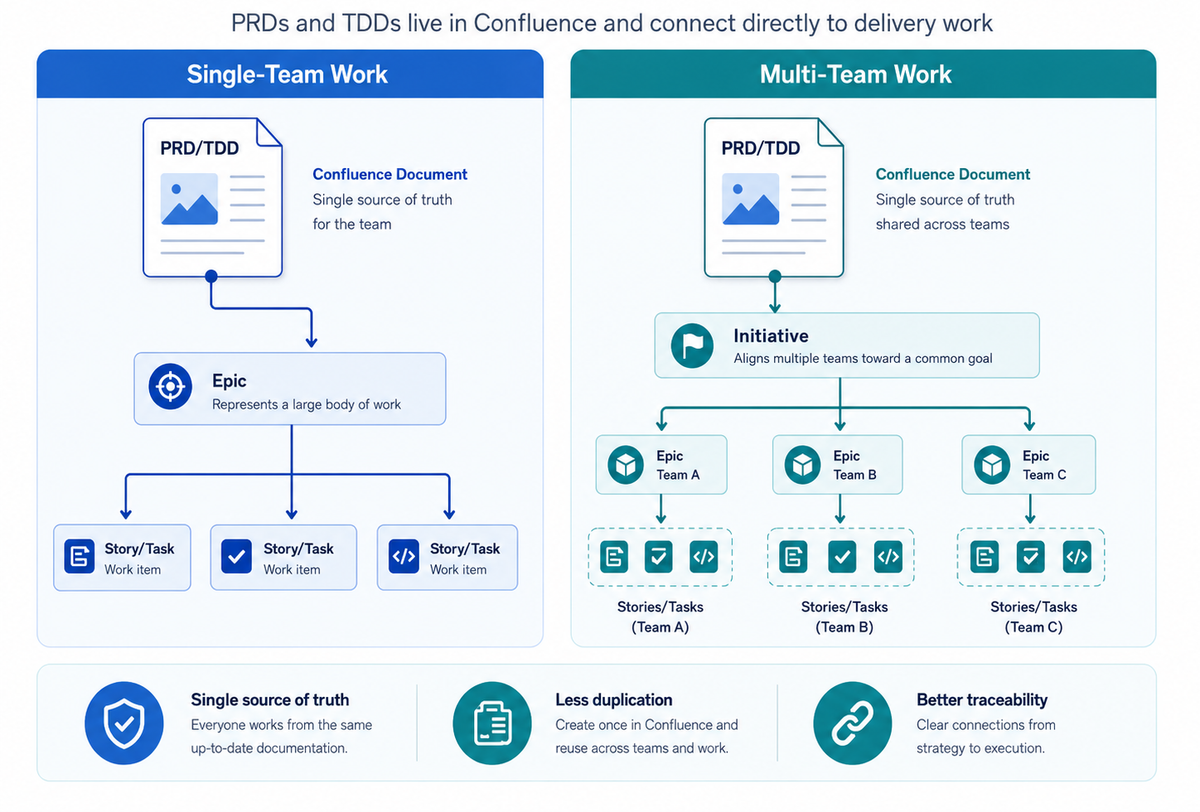
PRDs and TDDs now live in Confluence and are linked directly to the relevant delivery object.
For single-team work, those documents live at the Epic level.
For multi-team efforts, they live at the Initiative level so every participating team works from the same product and technical context.
The result is less duplication, better traceability, and a much cleaner historical record of why engineering decisions were made.
Release Governance Was the Next Major Step
Once the underlying structure was in place, we turned our attention to releases.
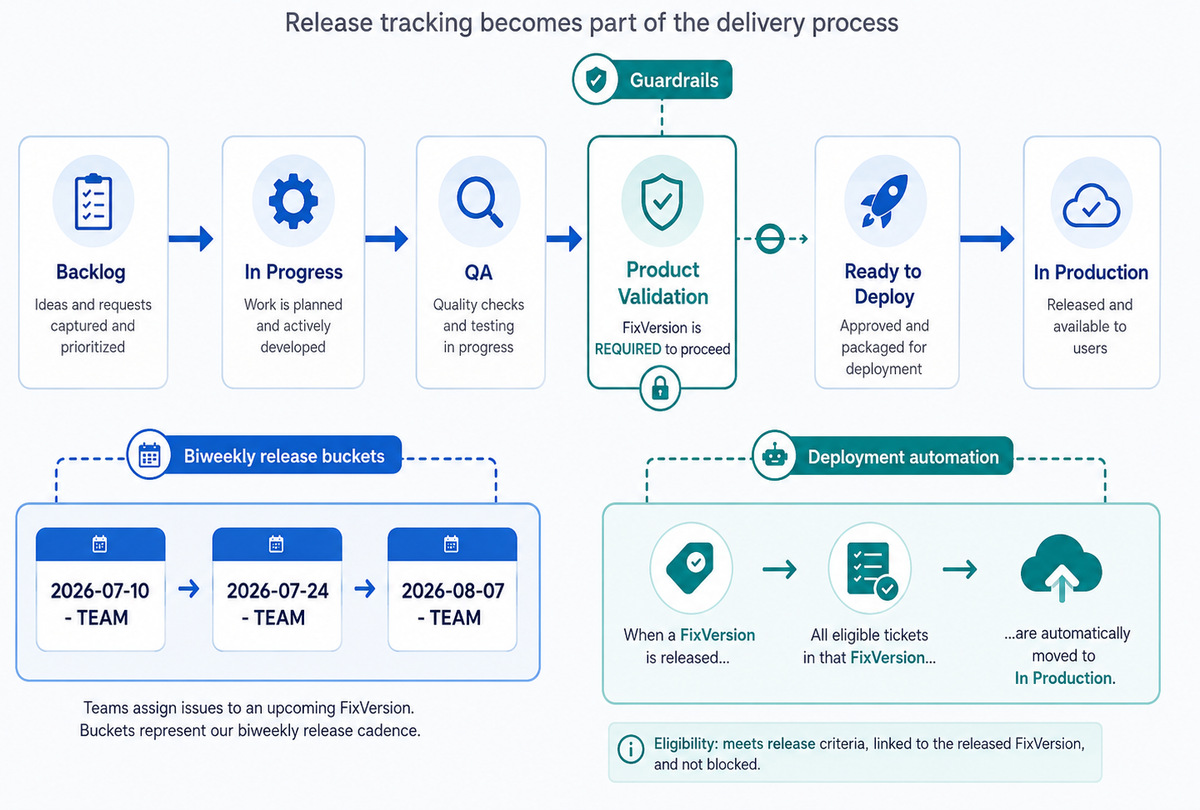
FixVersions became an important part of the operating model.
Rather than treating them as optional metadata, we used them as deployable work buckets that teams could plan against in advance.
The implementation eventually went further.
Workflow guardrails were introduced so work could not move into Product Validation without a FixVersion. The validation was applied across the development projects and tested across multiple transition paths.
Quarterly FixVersions were then created automatically for each team, complete with release dates.
This changed FixVersion from “another Jira field people forget to populate” into part of the actual delivery process.
The Workflow Began Enforcing the Governance
Good governance should not depend entirely on people remembering rules.
Where it made sense, we moved those rules into Jira itself.
The cross-project workflow was standardized into a more structured linear path with transition guardrails.
QA could not simply be bypassed.
Product Validation required a release version.
Deployment automation was introduced so that when a FixVersion was released, qualifying tickets could automatically move into an In Production state.
At that point, Jira was no longer just documenting the process.
It was helping enforce it.
Cross-Team Planning Became Useful Because the Data Was Finally Trustworthy
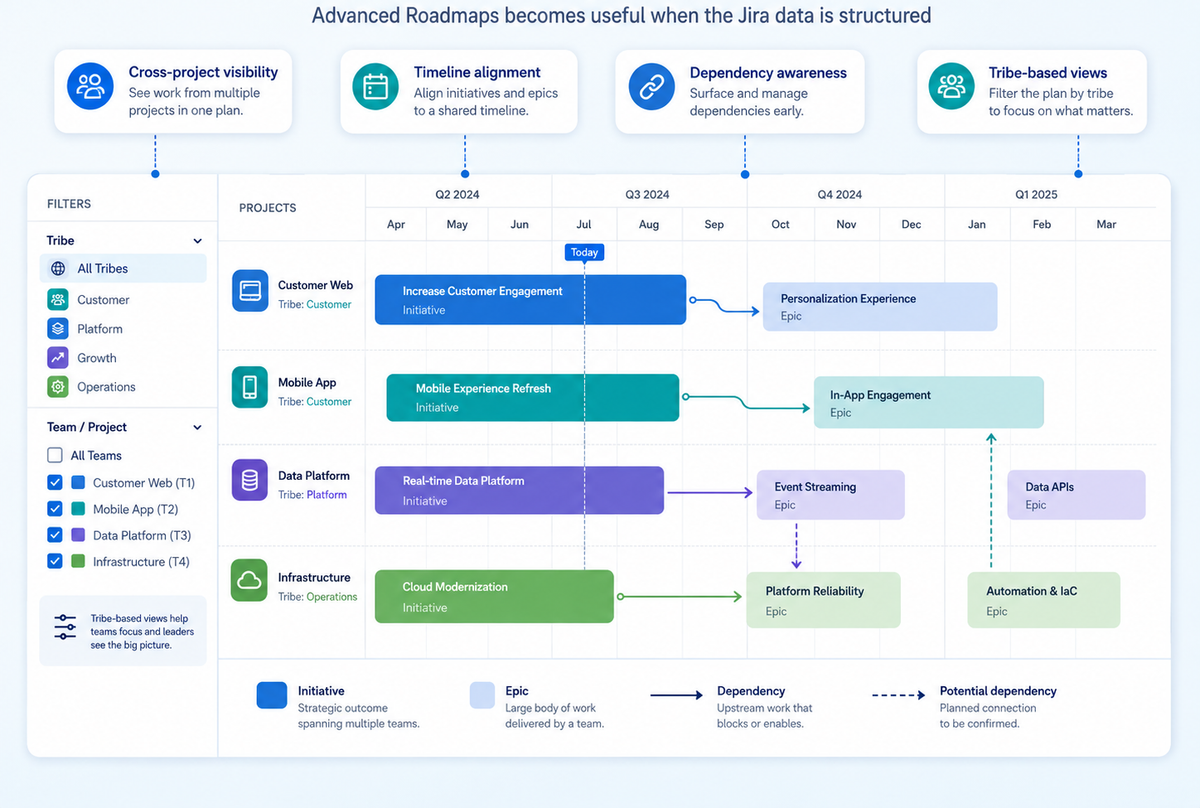
With the foundation in place, we configured a cross-team Advanced Roadmaps Plan covering the four development projects and relevant support work.
The first use case was intentionally not capacity planning.
That is another lesson from this engagement.
Organizations often want capacity forecasting immediately. But capacity models built on inconsistent estimation and immature sprint history produce very precise-looking numbers that nobody should trust.
Instead, Advanced Roadmaps initially focused on:
- Cross-project visibility
- Initiative and Epic hierarchy
- Sprint alignment
- Tribe-level filtering
- Timeline visibility
- Dependency awareness
- Status-based planning views
Capacity planning can be layered in later when the organization has enough consistent delivery data to make the model meaningful.
That is a much healthier progression than forcing a maturity level the teams have not reached yet.
Reporting Became Operational Instead of Performative
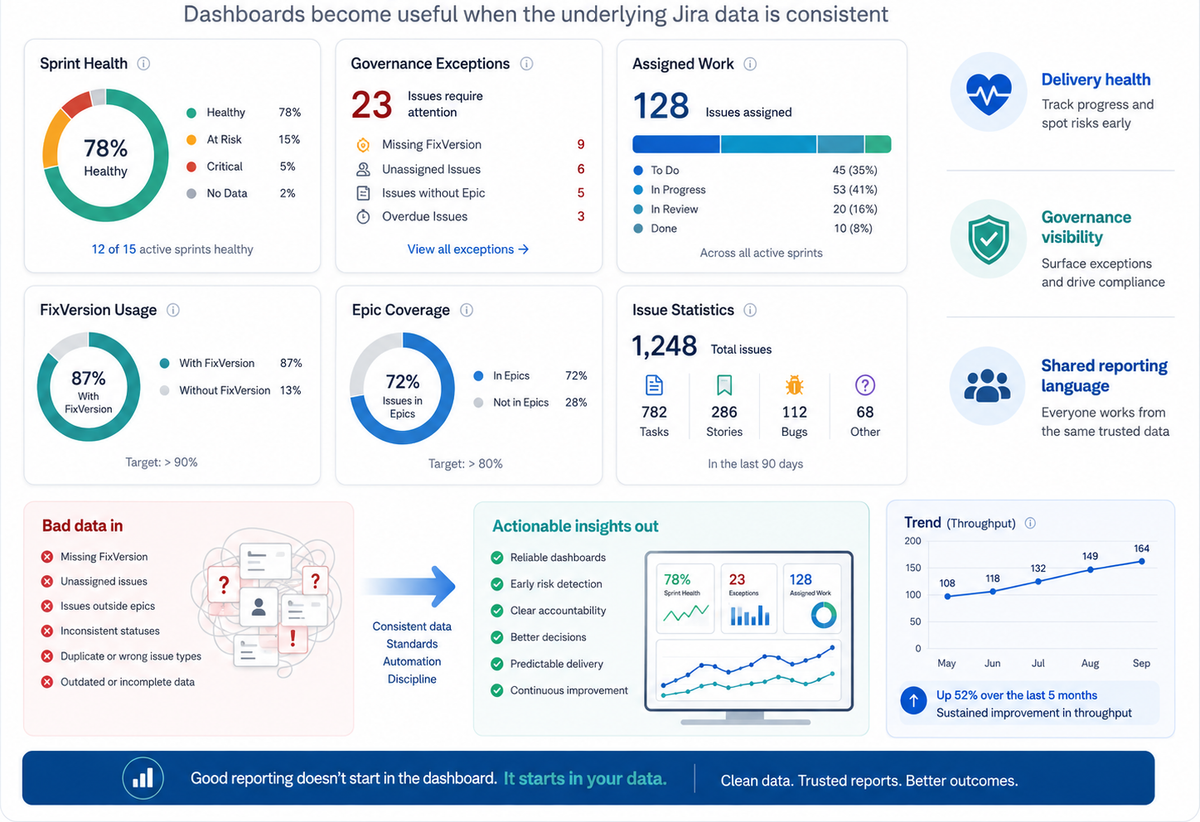
We also created governance and engineering dashboards that surfaced the information teams and leaders actually needed.
Those dashboards included views into:
- Sprint health
- Team activity
- Assigned work
- Flagged tickets
- FixVersion usage
- Epic-link coverage
- Issue statistics
- Governance exceptions
This is where the value of all the earlier cleanup becomes obvious.
Dashboards become substantially more useful when fields are consistently populated, issue relationships are meaningful, and workflows represent the way engineering actually operates.
Without governance, a dashboard is often just a prettier version of bad data.
We Standardized Estimation Across Engineering and Support
Another issue emerged when support work needed to participate in engineering planning.
The support project was using a different Story Point field than the engineering projects.
That sounds small.
It isn't.
When estimation fields differ, cross-project planning and reporting become unnecessarily difficult.
We migrated the existing estimates, updated the support project's create, edit, and view screens, removed the conflicting field, and standardized the organization on Jira's global Story Points field.
The migration included staged automation, backups, and comparison checks to make sure historical estimates were preserved correctly.
The result was one estimation model that could support both support-driven work and engineering Scrum planning.
What Changed
By the end of the implementation, the organization had moved significantly beyond simply “cleaning up Jira.”
It had an operating model.
Cross-project workflows were standardized.
QA could not be bypassed.
Release information became mandatory at the appropriate point in the workflow.
FixVersions were generated in advance.
Deployment events could drive ticket state automatically.
Engineering and support work shared the same estimation model.
Leadership had a cross-team planning view.
Teams had dashboards that exposed both delivery health and governance exceptions.
And, most importantly, the organization now had a structure that could evolve.
Advanced capacity planning, forecasting, deeper automation, and portfolio reporting can be added incrementally because the underlying Jira data is now capable of supporting them.
The Bigger Lesson
Jira governance is not about forcing every engineering team to work exactly the same way.
It is about deciding where consistency matters.
Teams can still have different products, technical architectures, and delivery challenges.
But the organization should agree on things like:
- What an Epic means
- How work rolls up
- How releases are identified
- Where product and technical documentation lives
- How customer-driven work is classified
- How estimates are recorded
- What must be true before work moves through key workflow gates
- How leadership gets a trustworthy view across teams
Once those rules exist, Jira stops feeling like a collection of unrelated project boards.
It starts becoming an engineering management system.
Is Your Jira Actually Helping You Run Engineering?
If your organization has multiple Jira projects and every team has developed its own way of using them, adding another dashboard or purchasing another Atlassian product probably isn't going to solve the underlying problem.
You may need governance first.
Temple Fourth Technologies helps engineering and product organizations assess how Jira is actually being used, identify the gaps that prevent reliable planning and reporting, and build governance that supports the way teams really work.
That can include Jira Product Discovery, Advanced Roadmaps, workflow design, release governance, automation, reporting, estimation standards, documentation practices, and cross-team planning.
The goal isn't to make Jira more complicated. It's to make it work for you.
This implementation is just a step towards a better operational model than what they had previously. Is it Agile? Probably not as much as it should be - but that's not the point. Agile is a journey and this is what the team was ready for.
It's to make Jira finally tell you the truth about how your organization is delivering software.
If your Jira environment has grown faster than the processes around it, let's talk. Temple Fourth Technologies can help you turn it into an operating model your engineering teams and leadership can actually rely on.